If you are in Class 12 and preparing for NEET, you are preparing for two Physics exams on one syllabus. The chapters are the same. The papers are not. The board paper rewards written steps, labelled diagrams and NCERT's exact sentences. NEET rewards speed, recall and spotting the condition a statement breaks. Students who prepare for one and hope it covers the other often lose marks in the one they neglected.
Class 12 Physics for Boards and NEET Together: What Overlaps and a Working Plan
CBSE Class 12NEET Physicsboard examderivationsstudy plan
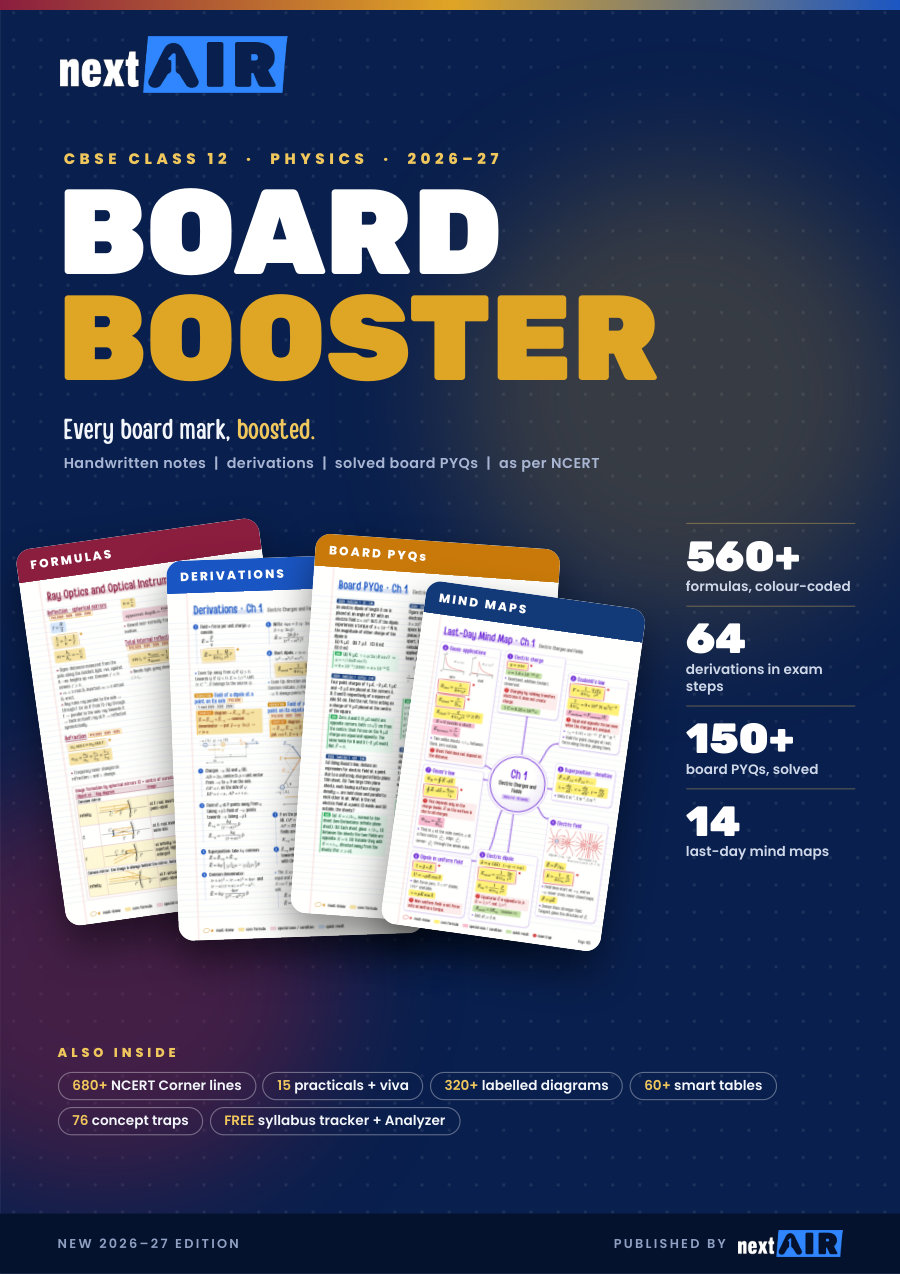
The book this guide is about
Board Booster: Class 12 Physics for CBSE BoardsFormulas, 64 derivations in exam steps and 150+ solved board PYQs. 2026-27.
142 pages8 pages free· Read in the nextAIR reader
The free pages open with a free nextAIR account.
This guide sets out what overlaps, what does not, and a plan that prepares both from one study of each chapter. Board Booster is nextAIR's Class 12 book written for exactly this. It sets out 64 derivations in the steps examiners mark, with solved board PYQs, and its first pages are free to read with a nextAIR account.
The same 14 chapters
The CBSE 2026-27 Class 12 Physics syllabus (subject code 042) has 14 chapters in nine units: Electric Charges and Fields, Potential and Capacitance, Current Electricity, Moving Charges and Magnetism, Magnetism and Matter, Electromagnetic Induction, Alternating Current, Electromagnetic Waves, Ray Optics, Wave Optics, Dual Nature, Atoms, Nuclei and Semiconductor Electronics. The theory paper is 70 marks; practical work is 30. Check the unit-wise marks and the question pattern for your year in the official curriculum and sample paper on cbseacademic.nic.in, because they are revised.
The 2026 NEET syllabus (NMC, notified December 2025) covers the same chapters, in its Physics units 11 to 19. So there is no Class 12 chapter you can drop for either exam.
The two exams weight them differently. In nextAIR's tagged NEET papers, the Class 12 chapters account for nearly three-fifths of the Physics questions in the eight papers of 2023–2026. Current Electricity, Semiconductor Electronics, Capacitance, Ray Optics and Dual Nature lead.


Airo · adaptive coach
Reading is the first half. I pick practice questions the way the examiner sets a paper — and show you why each one.
Start practicingWhat the board paper asks that NEET does not
- Derivations, written out. Marks go to the diagram, the starting law, each key step and the result with units. A NEET student who "knows" the result but skips the steps loses marks.
- Labelled diagrams. Ray diagrams for microscopes and telescopes, the AC generator, the p-n junction under bias, field lines. Unlabelled diagrams lose marks.
- Definitions and statements in NCERT's words. One-mark questions are often lifted from NCERT lines.
- Case-based and long-answer questions, where the reasoning is marked, not only the answer.
- The practical exam: the experiments, a record and a viva.
What NEET asks that the board paper does not
- Speed. Recent NEET papers have allowed about a minute a question.
- Numericals with traps: a wrong option is often the value a common slip gives (a missing factor of 2, a sign, a unit).
- Statement and assertion-reason questions, where one wrong condition makes a statement false.
- Graphs read for slope, area and intercept.
- Negative marking, so a guess has a cost.
Where the two meet
- Concepts. One careful study of a chapter serves both.
- Derivations help NEET more than students think. Deriving the field on the axis of a dipole once makes the 2kp/r³ result impossible to forget, and shows you why it needs r much larger than the dipole length. That condition is a NEET trap.
- The NEET Experimental Skills unit overlaps the board practicals. The 2026 NEET syllabus lists Class 12 experiments such as the resistivity of a wire with a metre bridge, Ohm's law, the resistance and figure of merit of a galvanometer, focal lengths of mirrors and a convex lens, the angle of deviation against angle of incidence for a prism, and the characteristics of a p-n junction and a Zener diode. Doing them properly for the board practical is NEET preparation too.
A plan from now to the exams
This assumes the board exam in its usual February–March window and NEET after it. The NEET 2027 date has not been announced; adjust when it is.
Until the end of December: one study of each chapter, for both.
- Study the chapter for concepts once, from NCERT.
- The same week, practice 20–30 NEET-style questions on it, timed. Each chapter on nextAIR has its own practice and test.
- Then write that chapter's derivations by hand, twice, in board format.
- Note the NCERT lines that read like definitions or statements.
January: board mode.
- Two derivations a day, written in full, against a timer.
- One past board paper or CBSE sample paper a week, timed and self-marked against the marking scheme.
- Finish the practical record. Revise the viva questions for each experiment.
- Keep NEET alive with one short timed practice set a day. Do not stop completely; speed fades when it is not used.
The board exam period: board only. Use the chapter mind maps and NCERT lines the night before each paper.
From the last board paper to NEET: full NEET mode. Mocks, error analysis, and the Class 11 chapters you have not touched since autumn.
Which derivations matter most for boards?
Work from the current CBSE sample paper and recent board papers rather than a list somebody else made. The recurring ones are well known: the field of a dipole on the axis and the equator, Gauss's law for a line, a sheet and a shell, the parallel-plate capacitor with and without a dielectric and its stored energy, drift velocity and Ohm's law, the Wheatstone bridge condition, the field on the axis of a circular loop, the force between parallel currents, torque on a current loop, galvanometer conversion, motional emf, self and mutual inductance, the series LCR circuit and resonance, the mirror, lens and lens maker's formulas, refraction through a prism, Young's double-slit fringe width, Einstein's photoelectric equation, Bohr's radius and energy, and the de Broglie wavelength. Some results are not derived in NCERT's main text but are still asked; keep a separate list of those.
Should I study Class 11 Physics during Class 12 at all?
Yes, a little every week. Class 11 chapters are about two-fifths of NEET Physics, and the board exam does not test them, so they are the first thing to slip. One Class 11 chapter's short notes and a practice set each weekend is enough to stop the slide until boards are over.
Is a board-style answer ever wrong for NEET, or the reverse?
The physics never differs; the format does. One thing to watch is the sign convention in optics. Boards expect the Cartesian convention written out explicitly. NEET options are computed with it but do not ask you to show it. Use the same convention for both and the habit carries.
What we publish
Board Booster covers all 14 Class 12 chapters for the 2026-27 CBSE exam. It has 560+ colour-coded formulas, 64 derivations in exam steps, 150+ solved board PYQs tagged by year, 14 last-day mind maps, 680+ NCERT Corner lines, and 15 practicals with viva questions. The board blueprint and a syllabus tracker are inside. The first pages are free in the nextAIR reader with a free account, and the current price is on the book's page.
For the NEET side of the same chapters, Physics Decoded is the short-notes book across Class 11 and 12. Then practice a chapter to find out which side of the plan you are behind on.
Revise it from the book
Board Booster: Class 12 Physics for CBSE BoardsFormulas, 64 derivations in exam steps and 150+ solved board PYQs. 2026-27.
142 pages8 pages free· Read in the nextAIR reader
The free pages open with a free nextAIR account.
Now sit a NEET Physics test
Practice the exact questions this chapter is likely to ask — weighted by 13 years of real NEET papers.
Free · starts instantly · no signup
Keep reading
Current Electricity NEET PYQ (2013–2026): Topic-Wise Count, What Left the Syllabus, and Six Solved Questions
8 min read
Most Repeated Questions in NEET Physics (2013–2026): The Topics That Come Back, With Solved PYQs
9 min read
Modern Physics Graphs for NEET: Photoelectric, Bohr, Binding Energy and Diodes
7 min read