Updated 18 November 2026. Every number below is counted from nextAIR's PYQ pack: 4,858 NEET questions from 2013 to 2026, 1,215 of them Physics, each tagged to chapter, topic and subtopic.
Most Repeated Questions in NEET Physics (2013–2026): The Topics That Come Back, With Solved PYQs
NEET PhysicsPYQmost repeated questionschapterwisesolved PYQs
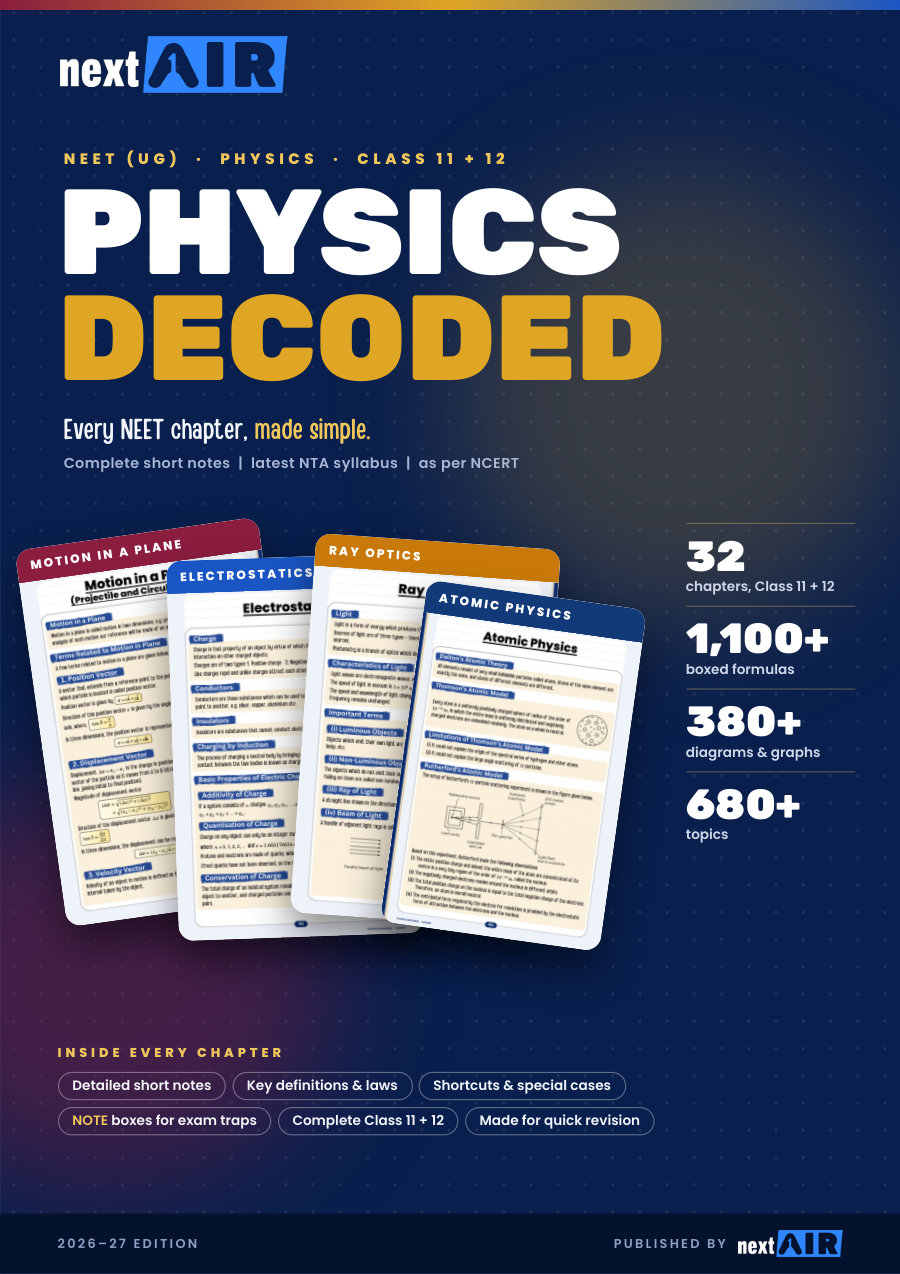
The book this guide is about
Physics Decoded: NEET Short NotesEvery NEET Physics chapter, made simple. Class 11 + 12 in 286 pages.
286 pages10 pages free· Read in the nextAIR reader
The free pages open with a free nextAIR account.
"Most repeated questions" means something different in Physics. In Biology, a fact can come back almost unchanged. NTA asked the same RNA polymerase question in 2021 and 2023. In Physics, the numbers change every time. What repeats is the situation: the same circuit, the same lens, the same electron in a Bohr orbit, with new values and often a new twist. So a list of old Physics questions with answers is worth little. A list of the situations the examiner returns to, and practice that varies them, is worth a lot.
This page gives that list. It is counted from every Physics question in the 2013–2026 papers, over two windows:
- Recent: the 8 sittings from 2023 to 2026 (the paper you will sit).
- Historical: the 17 sittings from 2013 to 2022.
Repeat rate is the share of the 8 recent sittings in which a topic appeared at least once. A topic at 75% was in 6 of the last 8 papers.
The most repeated NEET Physics topics
| Topic | Chapter | Repeat rate, 2023–26 | Per paper, 2023–26 | Per paper, 2013–22 | Asked 2013–26 |
|---|---|---|---|---|---|
| Electromagnetic waves: E, B and c | Electromagnetic Waves | 87.5% | 0.88 | 0.76 | 21 |
| Combination of resistors | Current Electricity | 75% | 1.12 | 0.53 | 19 |
| Bohr model of the hydrogen atom | Atoms | 75% | 1.12 | 0.59 | 20 |
| Digital electronics and logic gates | Semiconductor Electronics | 75% | 1.00 | 0.88 | 24 |
| Refraction at spherical surfaces and lenses | Ray Optics | 75% | 1.00 | 0.65 | 20 |
| Photoelectric effect | Dual Nature | 75% | 0.88 | 0.94 | 24 |
| Wave nature of matter (de Broglie) | Dual Nature | 75% | 0.75 | 0.82 | 21 |
| Moment of inertia | Rotational Motion | 75% | 0.75 | 0.47 | 15 |
| Kinematics of circular motion | Motion in a Plane | 75% | 0.75 | 0.35 | 12 |
| Errors in measurement | Units and Measurements | 62.5% | 0.75 | 0.29 | 11 |
| Vernier callipers | Units and Measurements | 62.5% | 0.62 | 0.12 | 7 |
| Series LCR circuit | Alternating Current | 62.5% | 0.75 | 0.24 | 10 |
| Special-purpose diodes (Zener, LED, photodiode) | Semiconductor Electronics | 62.5% | 0.75 | 0.12 | 8 |
| Simple harmonic systems (spring, pendulum) | Oscillations | 62.5% | 0.75 | 0.41 | 13 |
| Young's double-slit experiment | Wave Optics | 62.5% | 0.75 | 1.00 | 24 |
| Displacement current | Electromagnetic Waves | 62.5% | 0.62 | 0.18 | 8 |
| Acceleration due to gravity | Gravitation | 62.5% | 0.62 | 0.47 | 13 |
| Friction | Laws of Motion | 62.5% | 0.62 | 0.41 | 12 |
| Faraday's law of induction | Electromagnetic Induction | 62.5% | 0.62 | 0.35 | 11 |
| Kinetic theory of an ideal gas | Kinetic Theory | 62.5% | 0.62 | 0.59 | 15 |
| Stationary waves | Waves | 62.5% | 0.62 | 0.82 | 20 |


Airo · adaptive coach
Reading is the first half. I pick practice questions the way the examiner sets a paper — and show you why each one.
Start practicingThree things in this table matter more than any single row.
1. No Physics topic appeared in every recent paper. In Biology, ten topics did. The highest in Physics is electromagnetic waves, at 7 of 8. Physics spreads 45 questions across 28 chapters, so no topic is safe to bank on and none is safe to skip.
2. Almost every repeating topic is rising. Combination of resistors doubled (0.53 → 1.12 a paper). So did the Bohr model (0.59 → 1.12). Circular motion, the LCR circuit, displacement current and the special diodes rose from rare to regular. The 2023–2026 papers lean on a smaller set of standard situations than the older ones did.
3. Measurement is new weight. Vernier callipers rose from 0.12 a paper to 0.62, and errors in measurement from 0.29 to 0.75. Both sit under "Experimental Skills", unit 20 of the current syllabus. A Physics PYQ book built from the pre-2023 papers barely covers them.
Two old favourites are cooling: Young's double-slit (1.00 → 0.75) and stationary waves (0.82 → 0.62). Both still appear in most papers.
The chapters, in one line each
Per paper in 2023–2026, the heaviest Physics chapters are:
- Current Electricity, 3.25
- Semiconductor Electronics, 2.88
- Units and Measurements, 2.75 (up from 1.65)
- Electrostatic Potential and Capacitance, 2.50
- Ray Optics, 2.38
- Laws of Motion, 2.12
- Dual Nature, 2.12
- Alternating Current, 2.00
The steepest falls are Rotational Motion (2.35 → 1.62), Thermal Properties (1.59 → 0.75), Waves (1.59 → 0.88) and Thermodynamics (1.88 → 1.12). The full ranked table for all three subjects is in NEET 2027 chapter-wise weightage. Physics Decoded, nextAIR's chapter notes for NEET Physics, is organised around the same counts.
Four solved PYQs from the topics that repeat
1. Electromagnetic waves (NEET 2025 Q9). The electric field of a plane EM wave is E_z = 60 cos(5x + 1.5 × 10⁹ t) V/m. What is the magnetic field?
Solution. Read the wave first. The argument (kx + ωt) has a plus sign, so the wave travels along −x. Its speed is ω/k = 1.5 × 10⁹ / 5 = 3 × 10⁸ m/s, which checks out as light. The magnitude is B₀ = E₀/c = 60 / (3 × 10⁸) = 2 × 10⁻⁷ T. The direction comes from E × B pointing along propagation: ẑ × ŷ = −x̂, so B is along y. Answer: B_y = 2 × 10⁻⁷ cos(5x + 1.5 × 10⁹ t) T. The options test the two slips that repeat: putting B along x (the direction of travel) and forgetting to divide by c.
2. Errors in measurement (NEET 2025 Q42). P = a³b² / (c√d), with errors of 1%, 3%, 2% and 4% in a, b, c and d. What is the percentage error in P?
Solution. For a product of powers, the relative errors add, each multiplied by its power, whatever the sign of the power. So ΔP/P = 3(1%) + 2(3%) + 1(2%) + ½(4%) = 3 + 6 + 2 + 2 = 13%. The trap is subtracting the errors of c and d because they sit in the denominator. Errors never cancel.
3. de Broglie meets Bohr (NEET 2025 Q34). What is the de Broglie wavelength of the electron in the n = 2 state of hydrogen? The Bohr radius is 0.052 nm.
Solution. Bohr's condition says a whole number of wavelengths fits the orbit: 2πr_n = nλ. The radius grows as n², so r₂ = 4 × 0.052 = 0.208 nm. Then λ = 2πr₂ / 2 = π × 0.208 ≈ 0.65 nm. Closest option: 0.67 nm. Two repeating topics in one question, which is typical of the recent papers.
4. Bohr model with a different force (NEET 2025 Q30). A particle moves about the origin under a constant attractive force F. Apply the Bohr model: how do r and v depend on n?
Solution. Use the same two equations as for hydrogen, but with the force replaced. Circular motion gives mv²/r = F. Quantisation gives mvr = nh/2π, so v = nh / (2πmr). Substitute into the first: m·n²h² / (4π²m²r²) = Fr, which gives r³ ∝ n², or r ∝ n^(2/3). Then v ∝ n/r ∝ n^(1/3). Answer: r ∝ n^(2/3), v ∝ n^(1/3). This is the clearest example of the way Physics "repeats". The method is the Bohr model you already know; only the force law is new.
How to use repeat rates in Physics
- Learn the situation, not the answer. For each topic in the table, be able to set up the two or three equations from scratch. Then vary one quantity and solve it again. That is what the next paper will do.
- Pair a formula with its condition. Most wrong Physics answers use a correct formula where it does not hold. Formula Flash is nextAIR's formula book built that way, with the condition beside every formula.
- Practice the rising topics first. Combination of resistors, the Bohr model, measurement and the LCR circuit are all repeating more than before.
- Time yourself. Physics questions are the ones that run long. Sit a real paper as a timed CBT test: NEET 2025 or the 2026 re-exam, both 180 questions, marked +4/−1. Or take a NEET Physics mock test.
Frequently asked questions
Which Physics topics are most repeated in NEET?
Electromagnetic waves appeared in 7 of the 8 sittings from 2023 to 2026. Eight more topics appeared in 6 of 8: combination of resistors, the Bohr model, logic gates, refraction by lenses, the photoelectric effect, de Broglie waves, moment of inertia and circular motion.
Are NEET Physics questions repeated word for word?
We found none. We compared the 425 official Physics questions from nine NEET papers (2018 and 2020–2026), and none came back with the same wording. The situations repeat with new numbers. That is why practicing varied questions on a topic works better than memorising old answers.
Which Physics chapter has the highest weightage in NEET?
Current Electricity, at 3.25 questions a paper in the 2023–2026 sittings, followed by Semiconductor Electronics (2.88) and Units and Measurements (2.75).
Which Physics chapters have lost weight in NEET?
Rotational Motion (2.35 → 1.62 a paper), Thermal Properties of Matter (1.59 → 0.75), Waves (1.59 → 0.88) and Thermodynamics (1.88 → 1.12), comparing 2013–2022 with 2023–2026. All four are still in the syllabus and still asked.
Is Units and Measurements important for NEET?
Yes, more than before. It drew 2.75 questions a paper in 2023–2026, up from 1.65, mostly from errors in measurement and the Vernier callipers. These come under the syllabus unit "Experimental Skills".
Where these numbers come from
- Counts, rates and repeat rates: nextAIR's PYQ pack (
pyq-topic-yield.json): 1,215 Physics questions from the 2013–2026 papers. The recent window is 8 sittings (2023, 2023 Manipur, 2024, 2024 N6, 2024 re-exam, 2025, 2026, 2026 re-exam). - Repeat check: the official NTA question text for the 2018 and 2020–2026 papers in nextAIR's bank, compared by stem.
- Syllabus: the NEET (UG) 2026 syllabus as notified by the NMC on 22 December 2025.
- Questions quoted: from NTA's published papers. The solutions are nextAIR's own.
Revise it from the book
Physics Decoded: NEET Short NotesEvery NEET Physics chapter, made simple. Class 11 + 12 in 286 pages.
286 pages10 pages free· Read in the nextAIR reader
The free pages open with a free nextAIR account.
Now sit a NEET Physics test
Practice the exact questions this chapter is likely to ask — weighted by 13 years of real NEET papers.
Free · starts instantly · no signup
Keep reading
Current Electricity NEET PYQ (2013–2026): Topic-Wise Count, What Left the Syllabus, and Six Solved Questions
8 min read
Coordination Compounds NEET PYQ (2013–2026): Topic-Wise Count and Six Solved Questions
7 min read
Class 11 vs Class 12 Weightage in NEET: The Split by Subject, Counted From 2013–2026 Papers
7 min read