Updated 18 November 2026. Counts are from nextAIR's PYQ pack: 4,858 NEET questions from 2013 to 2026, each tagged to its chapter, and each chapter placed in its Class 11 or Class 12 NCERT book.
Class 11 vs Class 12 Weightage in NEET: The Split by Subject, Counted From 2013–2026 Papers
NEET 2027Class 11Class 12weightagePYQpreparation
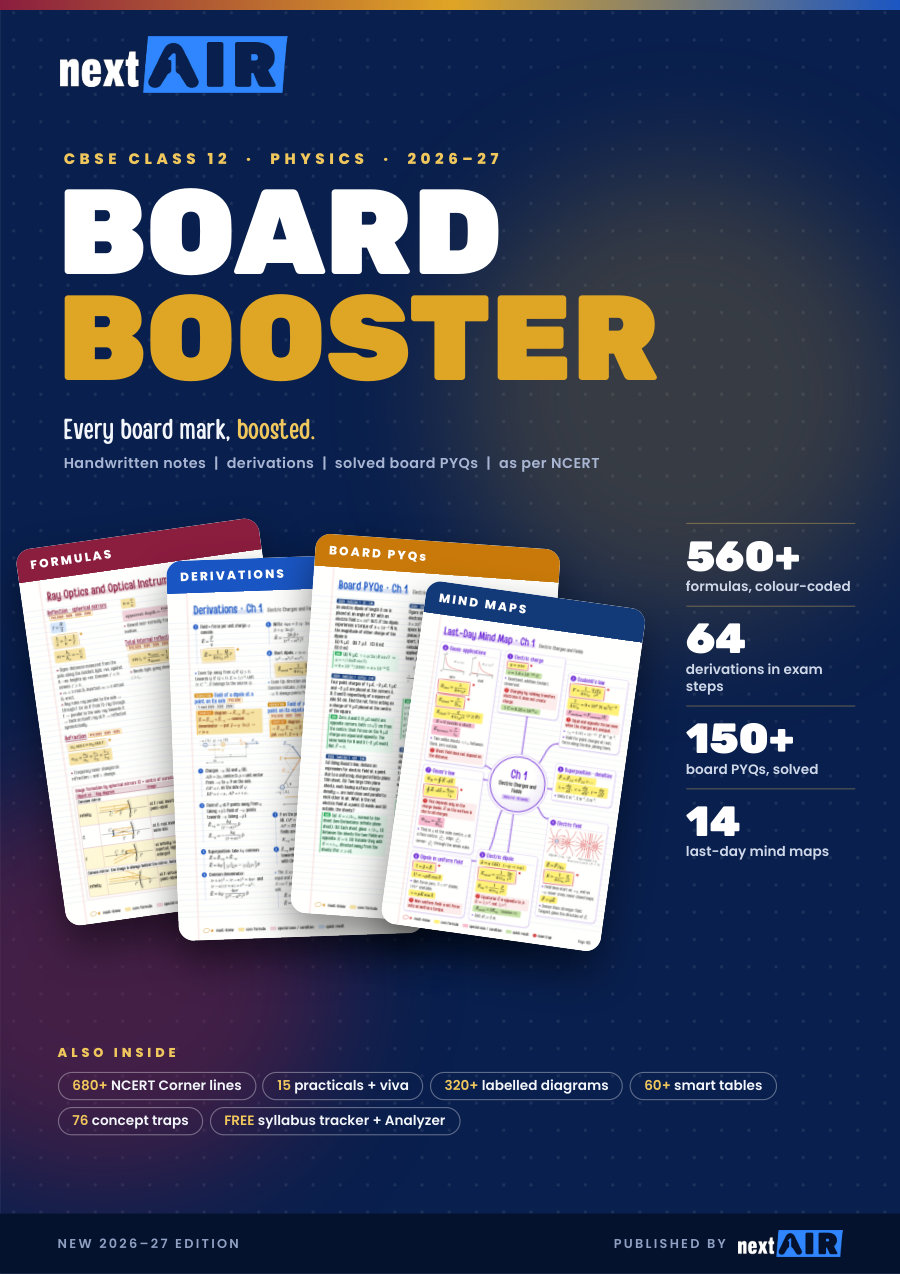
The book this guide is about
Board Booster: Class 12 Physics for CBSE BoardsFormulas, 64 derivations in exam steps and 150+ solved board PYQs. 2026-27.
142 pages8 pages free· Read in the nextAIR reader
The free pages open with a free nextAIR account.
In the 8 NEET sittings from 2023 to 2026, about 47% of the questions came from Class 11 chapters, about 51% from Class 12, and about 2% from units that span both (p-Block and practical chemistry). In 2013–2022, counting only chapters still in the syllabus, Class 11 was slightly ahead: 49% against 48.5%. So the paper is close to even, and Class 12 has gained a little since 2023.
The overall split hides the more useful fact: the three subjects lean in different directions.
The split, subject by subject
Shares of each subject's questions, per paper, for chapters in the 2026 syllabus:
| Subject | Class 11, 2023–26 | Class 12, 2023–26 | Both classes | Class 11, 2013–22 |
|---|---|---|---|---|
| Physics | 42% | 58% | — | 46% |
| Chemistry | 43% | 48% | 10% | 46% |
| Biology | 51% | 49% | — | 53% |
| Whole paper | 47% | 51% | 2% | 49% |
In a 180-question paper, that is roughly:
- Physics (45): about 19 from Class 11 and 26 from Class 12.
- Chemistry (45): about 19 from Class 11, 22 from Class 12 and 4 from p-Block and practical chemistry, which span both years.
- Biology (90): about 46 from Class 11 and 44 from Class 12.
Three things follow:
- Physics is the subject where Class 12 matters most. Its 14 Class 12 chapters drew 27.75 questions a paper in 2023–2026, against 20.4 from its 14 Class 11 chapters. Current Electricity alone (3.25) outweighs any Class 11 Physics chapter.
- Biology still leans to Class 11, because the Class 11 book has more chapters (19 against 13). Per chapter, Class 12 Biology is heavier: genetics, biotechnology and reproduction carry the biggest single counts.
- Every subject moved toward Class 12 after 2023. Class 11 Physics fell from 46% to 42%, Class 11 Chemistry from 46% to 43%, Class 11 Biology from 53% to 51%. Both columns count only chapters still in the 2026 syllabus, so this is not the syllabus trim at work. It is where the examiner now puts the questions.


Airo · adaptive coach
Reading is the first half. I pick practice questions the way the examiner sets a paper — and show you why each one.
Start practicingThe heaviest Class 11 chapters
Per paper, 2023–2026. If you are in Class 11 now, these are where your year pays most on NEET day.
| Subject | Chapter | Per paper |
|---|---|---|
| Biology | Biomolecules | 5.00 |
| Biology | Cell: The Unit of Life | 4.00 |
| Biology | Animal Kingdom | 3.62 |
| Biology | Structural Organisation in Animals | 3.50 |
| Biology | Morphology of Flowering Plants | 3.25 |
| Biology | Photosynthesis in Higher Plants | 3.25 |
| Biology | Cell Cycle and Cell Division | 3.12 |
| Chemistry | Chemical Bonding and Molecular Structure | 2.88 |
| Physics | Units and Measurements | 2.75 |
| Chemistry | Equilibrium | 2.62 |
| Chemistry | Hydrocarbons | 2.50 |
| Chemistry | Organic Chemistry: Some Basic Principles | 2.50 |
| Physics | Laws of Motion | 2.12 |
Two Class 11 surprises. Units and Measurements rose from 1.65 to 2.75 questions a paper, mostly on errors and the Vernier callipers. It is now the heaviest Class 11 Physics chapter. And Human Physiology (six Class 11 chapters) adds about 10.9 questions a paper together, though no single physiology chapter makes this list.
The heaviest Class 12 chapters
| Subject | Chapter | Per paper |
|---|---|---|
| Biology | Molecular Basis of Inheritance | 5.75 |
| Biology | Principles of Inheritance and Variation | 5.50 |
| Biology | Biotechnology: Principles and Processes | 4.88 |
| Biology | Organisms and Populations | 4.00 |
| Biology | Human Reproduction | 3.88 |
| Biology | Sexual Reproduction in Flowering Plants | 3.38 |
| Physics | Current Electricity | 3.25 |
| Chemistry | Coordination Compounds | 3.25 |
| Physics | Semiconductor Electronics | 2.88 |
| Physics | Electrostatic Potential and Capacitance | 2.50 |
| Chemistry | Chemical Kinetics | 2.50 |
| Chemistry | The d- and f-Block Elements | 2.50 |
| Chemistry | Aldehydes, Ketones and Carboxylic Acids | 2.50 |
What this means for your plan
- In Class 11: do not treat Class 11 as a warm-up. It is close to half the paper, and more than half of Biology. Physics is where Class 11 is lightest, but its chapters (mechanics, units, oscillations) are the tools Class 12 Physics uses, so they cannot be skipped. The year-by-year plan is in NEET 2027 for Class 11 students.
- In Class 12: keep a weekly slot for Class 11 revision. Students who let it slide are giving up nearly half the paper. Inside Class 12, Physics electricity and modern physics, and Biology genetics and biotechnology, are the biggest blocks.
- If you are restarting after Class 12: weight your hours by the per-paper counts, not by which class a chapter belongs to. NEET Biology PYQ chapterwise and NEET Chemistry PYQ chapterwise rank every chapter.
- Boards and NEET together: Board Booster is nextAIR's Class 12 Physics book, written for the board exam and NEET at once.
Two solved Class 11 PYQs
1. Solubility from Ksp (NEET 2026 re-exam Q52, Equilibrium). Order the solubility in water: AgBr (Ksp 5.0 × 10⁻¹³), Zn(OH)₂ (1.0 × 10⁻¹⁵), Hg₂Cl₂ (1.3 × 10⁻¹⁸).
Solution. Ksp values cannot be compared directly when the salts give different numbers of ions. AgBr is 1:1, so Ksp = s² and s = √(5.0 × 10⁻¹³) ≈ 7.1 × 10⁻⁷ M. Zn(OH)₂ gives one Zn²⁺ and two OH⁻, so Ksp = 4s³ and s = (2.5 × 10⁻¹⁶)^(1/3) ≈ 6.3 × 10⁻⁶ M. Hg₂Cl₂ gives one Hg₂²⁺ and two Cl⁻, also 4s³, so s = (3.25 × 10⁻¹⁹)^(1/3) ≈ 6.9 × 10⁻⁷ M. Order: Zn(OH)₂ > AgBr > Hg₂Cl₂. The salt with the smallest Ksp in the first two is the most soluble. That reversal is the whole question.
2. Haem enzymes (NEET 2025 Q131, Biomolecules). Which enzyme has haem as its prosthetic group: RuBisCo, carbonic anhydrase, succinate dehydrogenase or catalase?
Solution. NCERT's example of a prosthetic group is haem in peroxidase and catalase, which break down hydrogen peroxide. Carbonic anhydrase uses zinc as a cofactor; RuBisCo and succinate dehydrogenase are not haem enzymes. Answer: catalase. Biomolecules is the heaviest Class 11 chapter in NEET, at 5.0 questions a paper, and enzyme cofactors are a large part of it.
Practice either class free on nextAIR: every chapter link above opens practice that serves the most-asked concepts first. Or sit a full paper, timed and marked +4/−1: NEET 2025 is the first paper of the 180-question pattern.
Frequently asked questions
What is the weightage of Class 11 in NEET?
About 47% of questions in the 2023–2026 papers, counting chapters in the 2026 syllabus. Class 12 was about 51%, and p-Block and practical chemistry, which span both years, about 2%. In 2013–2022 Class 11 was about 49%.
Is Class 11 or Class 12 more important for NEET Physics?
Class 12. It drew about 58% of Physics questions in 2023–2026: about 26 of 45 questions, against 19 from Class 11. Current Electricity, Semiconductor Electronics and Electrostatic Potential lead.
What is the Class 11 Biology weightage in NEET?
About 51% of Biology in 2023–2026, roughly 46 of 90 questions. The heaviest Class 11 Biology chapters are Biomolecules (5.0 a paper), Cell: The Unit of Life (4.0) and Animal Kingdom (3.62).
What is the Class 11 Chemistry weightage in NEET?
About 43% of Chemistry in 2023–2026, with Class 12 at 48% and p-Block and practical chemistry (which span both years) at about 10%. Chemical Bonding (2.88 a paper) and Equilibrium (2.62) are the heaviest Class 11 chapters.
Can I skip Class 11 for NEET?
No. Class 11 chapters were close to half the paper in every window we measured, and more than half of Biology. The biggest single Class 11 chapter, Biomolecules, drew 5 questions a paper in 2023–2026.
Where these numbers come from
- Counts: nextAIR's PYQ pack (
pyq-topic-yield.json): per-paper rates over the 8 sittings of 2023–2026 and the 17 of 2013–2022. Only chapters in the 2026 syllabus are counted, so removed chapters do not inflate either window. - Class of each chapter: the rationalised NCERT Class 11 and Class 12 books. p-Block (split across both books) and Principles Related to Practical Chemistry (unit 20, XI+XII) are shown as "both".
- Syllabus: the NEET (UG) 2026 syllabus as notified by the NMC on 22 December 2025.
- Questions quoted: from NTA's published papers. The solutions are nextAIR's own.
Revise it from the book
Board Booster: Class 12 Physics for CBSE BoardsFormulas, 64 derivations in exam steps and 150+ solved board PYQs. 2026-27.
142 pages8 pages free· Read in the nextAIR reader
The free pages open with a free nextAIR account.
Stop reading. Start scoring.
Practice the exact questions this chapter is likely to ask — weighted by 13 years of real NEET papers.
Free · starts instantly · no signup
Keep reading
Current Electricity NEET PYQ (2013–2026): Topic-Wise Count, What Left the Syllabus, and Six Solved Questions
8 min read
Coordination Compounds NEET PYQ (2013–2026): Topic-Wise Count and Six Solved Questions
7 min read
Biotechnology NEET PYQ (2013–2026): Both Chapters Counted Topic by Topic, With Solved Questions
7 min read