NEET Physics is 45 questions, and they are not spread evenly. Some chapters appear in every paper with three questions; others show up once and then skip a year. If you know which is which, you can decide where your next revision hour goes. This guide gives the numbers for every chapter, explains where they come from, and turns them into a revision order.
NEET Physics Chapter-Wise Weightage: What Past Papers Show, Chapter by Chapter
NEET Physicschapter-wise weightagePYQrevision plan
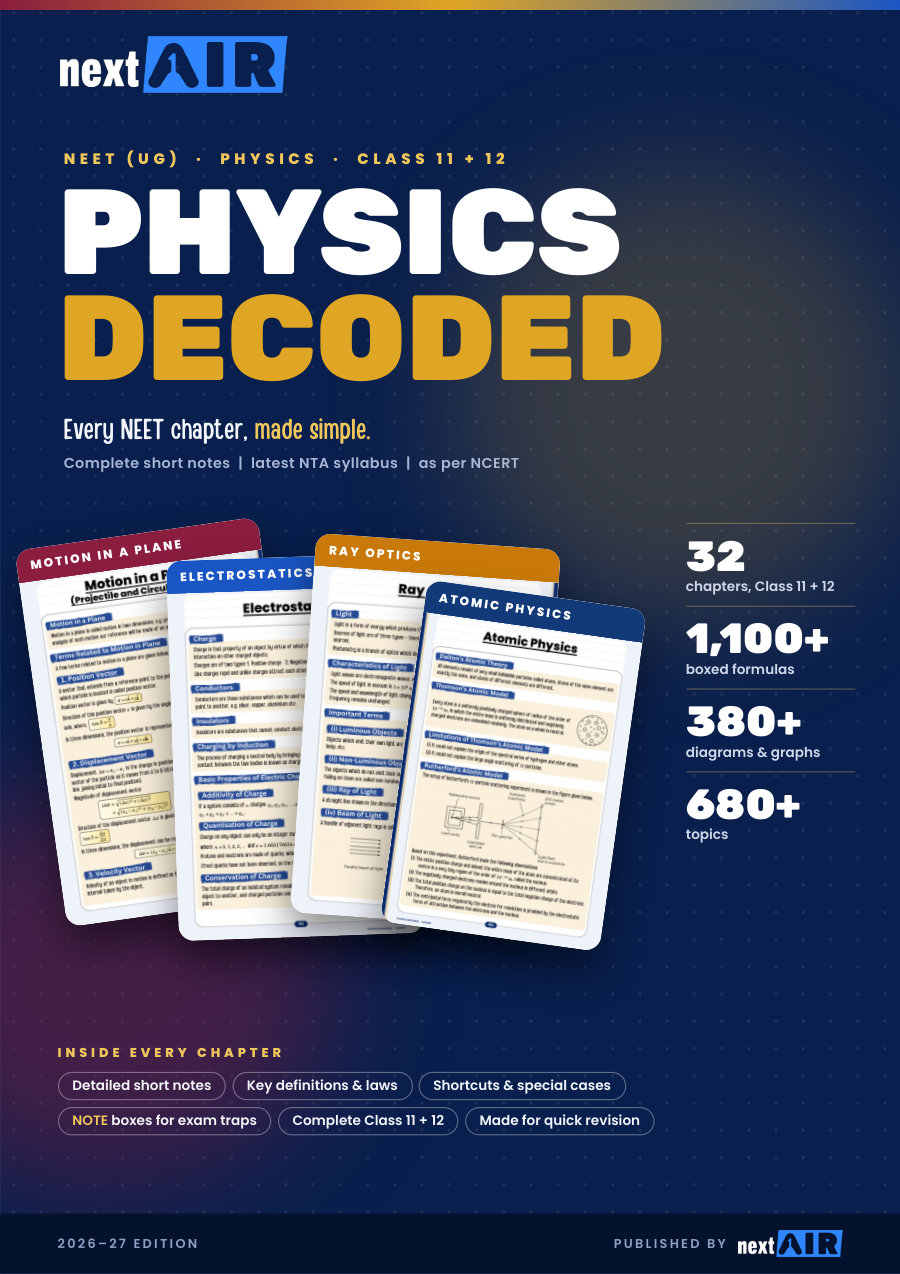
The book this guide is about
Physics Decoded: NEET Short NotesEvery NEET Physics chapter, made simple. Class 11 + 12 in 286 pages.
286 pages10 pages free· Read in the nextAIR reader
The free pages open with a free nextAIR account.
The short version: Current Electricity, Semiconductor Electronics, Units and Measurement, Capacitance and Ray Optics lead the recent papers, and electricity and magnetism together is about a third of the Physics section. To revise all of it in one place, Physics Decoded covers every chapter below in short-note form, and its first pages are free to read with a nextAIR account.
Where the numbers come from
Every figure here is counted from nextAIR's tagged set of NEET papers, 2013 to 2026: 4,858 tagged questions across all subjects, each mapped to a chapter of the current NCERT books. "Recent" means the eight papers from 2023 to 2026, including the 2023 Manipur paper and the 2024 and 2026 re-exams.
The numbers are averages per paper. A chapter at 2.0 got about two questions in a typical recent paper. Some papers gave it one, some three. Treat each figure as a measure of how much that chapter weighs, not a promise about the next paper. NTA does not publish a chapter-wise blueprint for NEET, so nobody can promise that.
The same data drives the chapter counts on every NEET Physics chapter page and the most-repeated PYQ topics list.
The table: every NEET Physics chapter, recent papers
| Chapter | Questions per paper, 2023–2026 | Trend |
|---|---|---|
| Current Electricity | 3.25 | steady |
| Semiconductor Electronics | 2.88 | steady |
| Units and Measurement | 2.75 | rising |
| Electrostatic Potential and Capacitance | 2.50 | steady |
| Ray Optics and Optical Instruments | 2.38 | steady |
| Laws of Motion | 2.12 | steady |
| Dual Nature of Radiation and Matter | 2.12 | steady |
| Alternating Current | 2.00 | rising |
| Gravitation | 1.88 | steady |
| Work, Energy and Power | 1.88 | rising |
| Electromagnetic Waves | 1.88 | rising |
| Atoms | 1.88 | rising |
| Moving Charges and Magnetism | 1.75 | steady |
| System of Particles and Rotational Motion | 1.62 | falling |
| Oscillations | 1.62 | rising |
| Electromagnetic Induction | 1.62 | rising |
| Magnetism and Matter | 1.62 | rising |
| Wave Optics | 1.50 | steady |
| Motion in a Straight Line | 1.50 | rising |
| Mechanical Properties of Fluids | 1.38 | steady |
| Motion in a Plane | 1.37 | steady |
| Electric Charges and Fields | 1.25 | steady |
| Thermodynamics | 1.12 | falling |
| Nuclei | 1.12 | falling |
| Kinetic Theory | 1.00 | steady |
| Waves | 0.88 | falling |
| Thermal Properties of Matter | 0.75 | falling |
| Mechanical Properties of Solids | 0.50 | steady |


Airo · adaptive coach
Reading is the first half. I pick practice questions the way the examiner sets a paper — and show you why each one.
Start practicing"Rising" and "falling" compare the eight recent papers with the seventeen before them. Units and Measurement, for example, averaged 1.65 questions a paper before 2023 and 2.75 since. Rotational Motion went the other way, from 2.35 to 1.62.
What the table says, in plain words
Electricity and magnetism is about a third of Physics. Current Electricity, Capacitance, Electric Charges and Fields, Moving Charges and Magnetism, Magnetism and Matter, Electromagnetic Induction and Alternating Current together average about 14 questions a paper. The Class 11 mechanics chapters, from Units and Measurement to Fluids, are the only block of similar size.
Two short Class 12 chapters punch far above their length. Semiconductor Electronics (diodes, special-purpose diodes and logic gates) and Dual Nature (photoelectric effect and de Broglie waves) are short in NCERT, yet they appeared in every recent paper with two to three questions each. Few chapters give as many questions for as few pages.
Units and Measurement is not a warm-up chapter any more. Its most-asked topics are errors and accuracy, dimensions, and the Vernier callipers. The instrument questions overlap with the Experimental Skills unit of the 2026 syllabus, which names the Vernier callipers and the screw gauge.
Heat and waves have cooled. Thermodynamics, Thermal Properties of Matter and Waves all appear less often than they used to. They have not vanished, so don't skip them, but don't start your revision there either.
The topics inside the top chapters
A chapter number hides the part that is actually asked. In the full 2013–2026 set:
- Current Electricity: combinations of resistors come up most, then electrical energy and power, and resistance.
- Semiconductor Electronics: logic gates lead clearly, then diode biasing and special-purpose diodes (LED, photodiode, solar cell, Zener).
- Ray Optics: refraction at spherical surfaces and by lenses, then the prism.
- Dual Nature: the experimental study of the photoelectric effect and the wave nature of matter, almost equally.
- Capacitance: energy stored and charge redistribution, the effect of a dielectric, and combinations.
Each chapter page on nextAIR lists its own most-asked topics. For example, see Current Electricity or Semiconductor Electronics.
A revision order built from the numbers
Weightage tells you where marks are. It does not tell you what you are bad at. A sensible order uses both:
- First pass, high weight and short: Semiconductor Electronics, Dual Nature, Units and Measurement, Atoms, Electromagnetic Waves. Five chapters, about eleven questions a paper, and none is long.
- Second pass, high weight and long: Current Electricity, Capacitance, Ray Optics, Laws of Motion, Alternating Current.
- Third pass, the mechanics core: Work Energy and Power, Gravitation, Rotational Motion, Motion in a Straight Line and in a Plane. Individually mid-weight; together about eight questions a paper.
- Fourth pass, everything else, in table order.
Inside each pass, start with the chapter you score worst on in practice. A chapter worth two questions that you get wrong every time is worth more revision than a three-question chapter you already get right.
Do the weights change much from year to year?
Less than students fear at the top, more at the bottom. Sixteen of the 28 chapters appeared in every one of the eight recent papers, including all of the top eight in the table. The chapters that skipped a paper are lower down: Electric Charges and Fields, Wave Optics, Nuclei, Magnetism and Matter, Thermal Properties and Mechanical Properties of Solids among them. Current Electricity has led across the whole 2013–2026 set as well as the recent papers.
Should I skip the low-weight chapters?
No. The seven lightest chapters in the table average 1.25 questions a paper or less, and together they are still about six and a half questions, some 26 marks. Skipping them all is a real cost. Revise them in short form: the definitions, the formulas and one or two standard questions each. That is what short notes are for.
Is the 2026 syllabus different from the papers these numbers come from?
The NMC's 2026 NEET syllabus (notified December 2025) reorganises Physics into 20 units and drops a few topics older papers asked about. The chapter counts above are mapped to the current NCERT chapters, and the dropped topics carry no weight in nextAIR's practice. If you are using an old book, check each chapter against the 2027 syllabus page before revising it.
How to use this with short notes
The table tells you which chapter to open. Then:
- Read that chapter's short notes once, start to finish.
- Close them and write down the formulas and the special cases from memory.
- Practice 15–20 questions on that chapter the same day. On nextAIR, a wrong answer makes the next question test the same idea.
- Re-read only the parts you got wrong.
Physics Decoded is written for exactly step 1: every chapter in the table, with boxed formulas, diagrams and the traps marked. Read the free pages first and see whether the style suits you. Then practice any Physics chapter for steps 3 and 4.
Revise it from the book
Physics Decoded: NEET Short NotesEvery NEET Physics chapter, made simple. Class 11 + 12 in 286 pages.
286 pages10 pages free· Read in the nextAIR reader
The free pages open with a free nextAIR account.
Now sit a NEET Physics test
Practice the exact questions this chapter is likely to ask — weighted by 13 years of real NEET papers.
Free · starts instantly · no signup
Keep reading
Current Electricity NEET PYQ (2013–2026): Topic-Wise Count, What Left the Syllabus, and Six Solved Questions
8 min read
Coordination Compounds NEET PYQ (2013–2026): Topic-Wise Count and Six Solved Questions
7 min read
Class 11 vs Class 12 Weightage in NEET: The Split by Subject, Counted From 2013–2026 Papers
7 min read