Search for NEET Physics revision material and you will find two kinds of product that look alike: short notes and formula sheets. Both are colourful, both are "chapter-wise", and both claim to save you time. They are not the same tool. Using the wrong one at the wrong stage is a common way to feel busy without getting better.
Short Notes or a Formula Sheet for NEET Physics? When Each One Helps
NEET Physicsshort notesformula sheetrevision
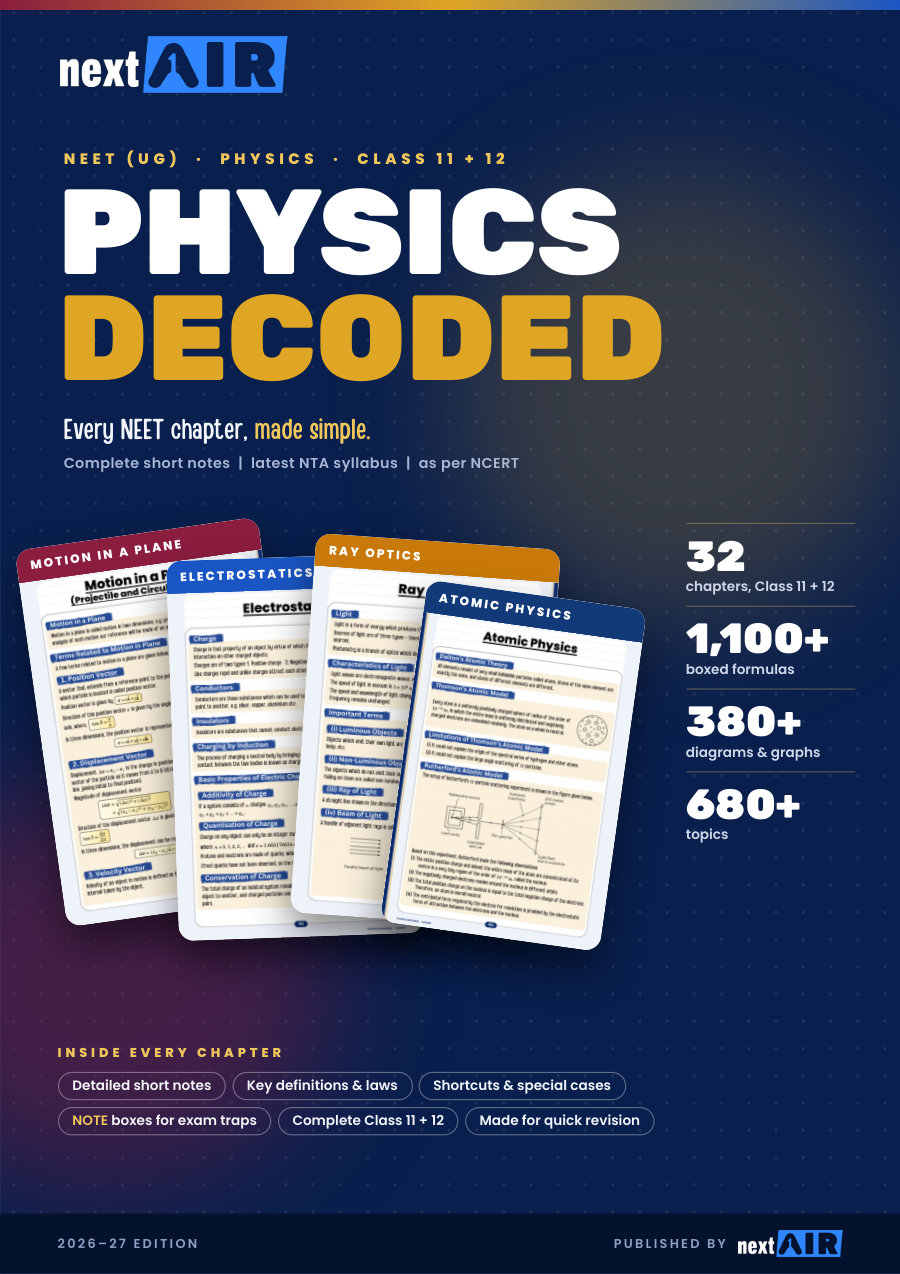
The book this guide is about
Physics Decoded: NEET Short NotesEvery NEET Physics chapter, made simple. Class 11 + 12 in 286 pages.
286 pages10 pages free· Read in the nextAIR reader
The free pages open with a free nextAIR account.
This guide explains the difference, says when each helps, and shows how to check either one before you pay. nextAIR publishes one of each, Physics Decoded (short notes) and Formula Flash (a formula sheet), so we have a stake in the answer. We have tried to write it so that it is useful even if you buy neither.
What short notes are for
Short notes compress a chapter's ideas, not just its equations. A good set of short notes for a chapter like Current Electricity holds:
- the definitions in NCERT's wording (drift velocity, mobility, resistivity, emf)
- the laws and the conditions under which they hold (Ohm's law for ohmic conductors at constant temperature)
- the key diagrams (a Wheatstone bridge, a metre bridge, a cell with its internal resistance)
- the formulas, boxed
- the standard results you would otherwise re-derive (equivalent resistance of symmetric networks)
- the traps examiners set (internal resistance ignored, a cell connected backwards)
Short notes help when you understand a chapter but have forgotten parts of it. That is the normal state of a Class 12 student revising Class 11, or a dropper starting the year. Reading a chapter's short notes usually takes under half an hour. Re-reading the NCERT chapter takes hours.
Short notes do not replace the first reading. If you never understood rotational motion, a three-page summary of it will not teach it to you. It will only remind you of things you never knew.


Airo · adaptive coach
Reading is the first half. I pick practice questions the way the examiner sets a paper — and show you why each one.
Start practicingWhat a formula sheet is for
A formula sheet strips the chapter down to the relations you must recall under time pressure: the formula, its units and, in a good sheet, its condition. A good sheet for Current Electricity is one or two pages: I = neAv (v the drift speed), R = ρl/A, the series and parallel rules, power in three forms (VI, I²R, V²/R), the cell equations, Kirchhoff's two laws, the balance condition of the bridge.
A formula sheet helps when the concepts are in place and the marks are leaking at recall: a forgotten factor of 2, a square root in the wrong place, a sign. That is mostly the last six to eight weeks, and especially the last week, when you want the whole syllabus in front of you in one sitting.
A formula sheet is dangerous earlier. Students who revise only from formulas learn to pattern-match. NEET Physics papers include statement-type and assertion-reason questions about conditions and concepts, and pattern-matching fails on those.
The difference in one table
| Short notes | Formula sheet | |
|---|---|---|
| Unit of content | ideas, laws, diagrams, formulas, traps | formulas, units, conditions |
| Time per chapter | under half an hour | a few minutes |
| Best stage | after first study; every revision cycle | last 6–8 weeks; last week; before each mock |
| Fixes | forgotten concepts, weak statements | recall errors in numericals |
| Fails at | teaching a chapter from scratch | concept and statement questions |
Which one should I start with?
If your mocks show wrong answers on statement, assertion-reason or "which of the following is correct" questions, start with short notes. Those mistakes are about concepts and conditions.
If your mocks show numericals where you knew the method but got the number wrong, start with a formula sheet. Those mistakes are about recall.
Most students have both kinds of mistake, in different chapters. Sort your last two mocks' wrong answers into the two piles, chapter by chapter, and you will know which tool each chapter needs.
How to judge either one before you pay
Every seller says "complete", "NCERT-based" and "latest syllabus". Check these instead, on whatever sample pages the seller shows:
- Pick one chapter you know well and read its sample. Is anything wrong? One wrong formula in a sample is a bad sign for the rest.
- Look for conditions. Does the sheet write "for constant acceleration" next to v = u + at, and "for small angles" next to T = 2π√(l/g)? A sheet without conditions trains exactly the mistakes NEET's wrong options are built on.
- Check the syllabus. The 2026 NEET syllabus (NMC, notified December 2025) removed some topics older material still covers. A book that still teaches deleted topics at length costs you time. Our 2027 syllabus page lists the current Physics units.
- Check the format against how you study. A printed book is easy to annotate but impossible to search. A PDF is searchable but easy to lose in a downloads folder. A web reader such as nextAIR's is searchable and synced across devices, but you cannot print it. None of these is better for everyone.
- Read enough sample to judge the style. A cover and a contents page tell you nothing. You want at least one full chapter's worth.
Can I make my own instead?
Yes, and making them teaches you something. The cost is time: writing good short notes for all of Physics takes weeks of study time, because every chapter has to be read again in full first. If you have that time early in Class 11, writing your own is a good use of it. If you are a dropper in November, or a Class 12 student balancing boards, a ready set lets you spend those hours on questions. Many students do both: they buy a set, then add their own mistakes to it in the margins.
A plan that uses both
From now until about eight weeks before NEET: for each chapter, in weightage order, read the short notes, then practice 15–20 questions the same day. Mark every wrong answer back into the notes.
The last eight weeks: switch the daily habit to the formula sheet, one full pass a day of under an hour. Keep the short notes for the chapters where mocks still show concept mistakes.
The last week: formula sheet only, plus the pages of short notes you marked most often.
Before every mock: five minutes on the formula sheet for the chapters you are weakest in.
What we publish
Physics Decoded is the short-notes book: every NEET Physics chapter of Class 11 and 12, plus Experimental Skills, with 1,100+ boxed formulas, 380+ diagrams and NOTE boxes for the traps. Formula Flash is the formula sheet: 1,046+ colour-coded formulas on 70 pages, with comparison tables for the pairs students confuse.
Both open in the nextAIR reader, and the first pages of each are free with a nextAIR account. Read the sample of the one you think you need, and use the checks above on it. The price is on each book's page. Then practice a chapter to see which kind of mistake you are actually making.
Revise it from the book
Physics Decoded: NEET Short NotesEvery NEET Physics chapter, made simple. Class 11 + 12 in 286 pages.
286 pages10 pages free· Read in the nextAIR reader
The free pages open with a free nextAIR account.
Now sit a NEET Physics test
Practice the exact questions this chapter is likely to ask — weighted by 13 years of real NEET papers.
Free · starts instantly · no signup
Keep reading
Current Electricity NEET PYQ (2013–2026): Topic-Wise Count, What Left the Syllabus, and Six Solved Questions
8 min read
Most Repeated Questions in NEET Physics (2013–2026): The Topics That Come Back, With Solved PYQs
9 min read
Class 12 Physics for Boards and NEET Together: What Overlaps and a Working Plan
6 min read